
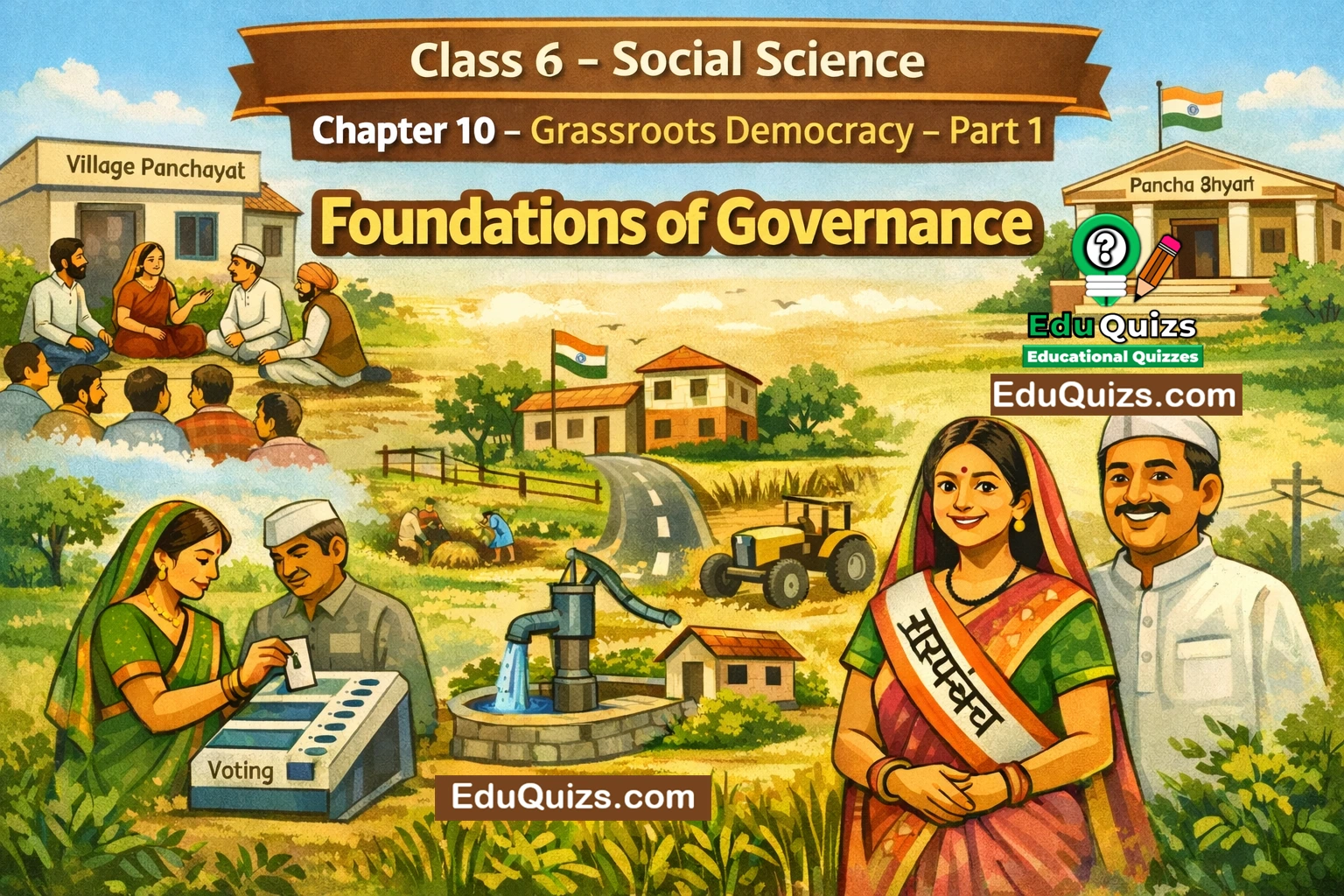
Class 6 Social Science Chapter 10 : Grassroots Democracy – Part 1 Governance Summary Notes in English for CBSE students
Class 6 Social Science Chapter 10 : Grassroots Democracy – Part 1 Governance Summary Notes. CBSE Class 6 Social Science Chapter 10 Notes & Summary in English for “Grassroots Democracy – Part 1 Governance” (based on NCERT Social studies textbook Exploring Society: India and Beyond).
SST Chapter 10 – Grassroots Democracy – Part 1 Governance Complete Notes
Class 6 Social Science – Exploring Society: India and Beyond
Theme D – Governance and Democracy
SST Chapter 10: Grassroots Democracy – Part 1 Governance
Class 6 Social Science Chapter 10 : Grassroots Democracy – Part 1 Governance Summary Notes.(Complete Notes + Concept-wise Explanation + Summary CBSE Class 6 Social Science – Exploring Society: India and Beyond (s.st.) Book)
Chapter 10: Grassroots Democracy – Part 1 Governance – Notes
Class 6 Social Science Chapter 10 : Grassroots Democracy – Part 1 Governance Summary Notes
BIG QUESTIONS OF THE CHAPTER
- What is governance?
- Why do we need a government?
- What is democracy and why is it important?
1. MEANING OF GOVERNANCE
When many people live together, differences, disputes, and confusion can arise. To keep order and ensure fairness, rules are necessary.
Governance means:
The process of making decisions, organizing society through rules, and ensuring that those rules are followed.
It includes:
- Making rules and laws
- Implementing them
- Making sure people follow them
Example:
Rules at home, rules in school, traffic rules on roads — all are forms of governance at different levels.
Without governance:
There would be disorder, conflict, and injustice, and society would not function properly.
Class 6 Social Science Chapter 10 : Grassroots Democracy – Part 1 Governance Summary Notes
Related Practice Questions:
- Class 6 Social Science Civics Chapter 10 Governance MCQs
- Class 6 Social Science Civics Chapter 10 Governance NCERT Question Answers
- Class 6 Social Science Civics Chapter 10 Governance Extra Important Questions
- Class 6 Social Science Civics Chapter 10 Governance Practice Worksheet
- Class 6 Social Science Civics Chapter 10 Governance True False Questions
- Class 6 Social Science Civics Chapter 10 Governance Fill in the Blanks
- Class 6 Social Science Civics Chapter 10 Governance Match the Following
- Class 6 Social Science Civics Chapter 10 Governance Summary Notes
2. WHAT IS GOVERNMENT?
The government is the group of people or system that:
- Makes rules and laws
- Ensures they are followed
Some important rules made by the government are called laws.
Important point:
Laws can be changed. Citizens can raise their voices, request changes, and influence rule-making.
3. WHY DO WE NEED A GOVERNMENT?
We need a government to:
- Maintain Law and Order
To prevent crime and punish wrongdoers. - Provide Public Services
Such as schools, hospitals, roads, transport, water, and electricity. - Protect the Country
Defence forces protect us from external threats. - Make and Implement Laws
So that everyone is treated fairly. - Solve Disputes
Through courts and the justice system. - Plan Development
For education, health, agriculture, and the economy.
Without a government, there would be chaos and no system to solve problems.
4. THREE ORGANS OF GOVERNMENT
A modern government has three main organs. Each has a different role.
1. Legislature (Makes Laws)
This organ:
- Makes new laws
- Changes or removes old laws
It consists of representatives elected by the people.
At the national level in India:
- Lok Sabha
- Rajya Sabha
At the state level:
- Vidhan Sabha (State Assembly)
2. Executive (Implements Laws)
This organ:
- Executes or carries out laws
- Runs the day-to-day administration
Includes:
- President (nominal head at Centre)
- Prime Minister (real executive head at Centre)
- Governor (nominal head at State)
- Chief Minister (real executive head at State)
- Police, government departments, officials
Example:
Cyber police catching online criminals is part of the executive.
3. Judiciary (Interprets Laws and Gives Justice)
This organ:
- Decides whether laws have been broken
- Gives punishment if needed
- Protects rights of people
- Checks whether laws and government actions are fair
Includes:
- Supreme Court (national level)
- High Courts (state level)
- Lower courts
5. SEPARATION OF POWERS
The three organs must be separate. This is called separation of powers.
Purpose:
- To prevent misuse of power
- To maintain checks and balances
Each organ can check the other:
- Judiciary can question laws
- Legislature can make new laws
- Executive must follow laws
If one group controlled all three, it could lead to dictatorship and injustice.
6. THREE LEVELS (TIERS) OF GOVERNMENT
India has three levels of government.
1. Local Government
Works at village, town, or city level.
Deals with:
- Street lights
- Cleanliness
- Water supply
- Local roads
2. State Government
Works at the state level.
Deals with:
- Police
- Public health
- Agriculture
- Irrigation
- State education matters
Headed by:
Chief Minister and Council of Ministers
3. Central (Union) Government
Works at the national level.
Deals with:
- Defence
- Foreign affairs
- Currency
- National policies
- Communications
Headed by:
Prime Minister and Council of Ministers
Example (Flood Situation):
- Small flood → Local government
- Larger flood → State government
- Massive disaster → Central government also helps
7. IMPORTANT POSITIONS (NOMINAL AND REAL HEADS)
Nominal Head:
Has position in name, limited day-to-day power.
- President of India (Centre)
- Governor (State)
Real Executive Head:
Actually runs the government.
- Prime Minister (Centre)
- Chief Minister (State)
8. DEMOCRACY
The word democracy comes from Greek words:
Demos = people
Kratos = rule
Meaning:
Democracy means rule of the people.
But people cannot all rule directly at large scale, so they choose representatives.
9. REPRESENTATIVE DEMOCRACY
India is a representative democracy.
People:
- Vote in elections
- Choose representatives
These representatives:
- Become MLAs (State level)
- Become MPs (National level)
- Make laws and decisions on behalf of people
India is the world’s largest democracy, with millions of voters.
10. DIRECT DEMOCRACY
In direct democracy:
People themselves take decisions directly.
Example:
Class voting for picnic place.
This is possible only in small groups, not in big countries.
11. GRASSROOTS DEMOCRACY
Grassroots democracy means:
Participation of ordinary citizens at the local level.
It encourages:
- People at the village or town level to take part in decision-making
- Democracy starting from the base of society
Local governments are an important part of grassroots democracy.
12. ROLE OF GOVERNMENT IN DAILY LIFE
Government affects our daily life through:
- Schools and education policies
- Hospitals and public health
- Roads and transport
- Electricity and water
- Law and order
- Digital laws and cybercrime control
Class 6 Social Science Chapter 10 : Grassroots Democracy – Part 1 Governance Summary Notes – CHAPTER SUMMARY
Governance is the process of making rules, organizing society, and ensuring rules are followed. The government is the system that carries out governance.
We need a government to maintain order, provide services, protect the country, make laws, and ensure justice. A modern government has three organs: legislature (makes laws), executive (implements laws), and judiciary (interprets laws and gives justice). These must remain separate to prevent misuse of power; this is called separation of powers.
India has three levels of government: local, state, and central. Each level handles different responsibilities depending on the scale of the issue.
India is a democracy, which means rule of the people. Since everyone cannot directly govern, people elect representatives. This system is called representative democracy. When people participate at the local level, it is called grassroots democracy.
Together, governance, government, and democracy help maintain order, justice, development, and participation in society.
Subscribe our Youtube Channel for video. Class 6 Social Science Chapter 10 : Grassroots Democracy – Part 1 Governance Summary Notes