
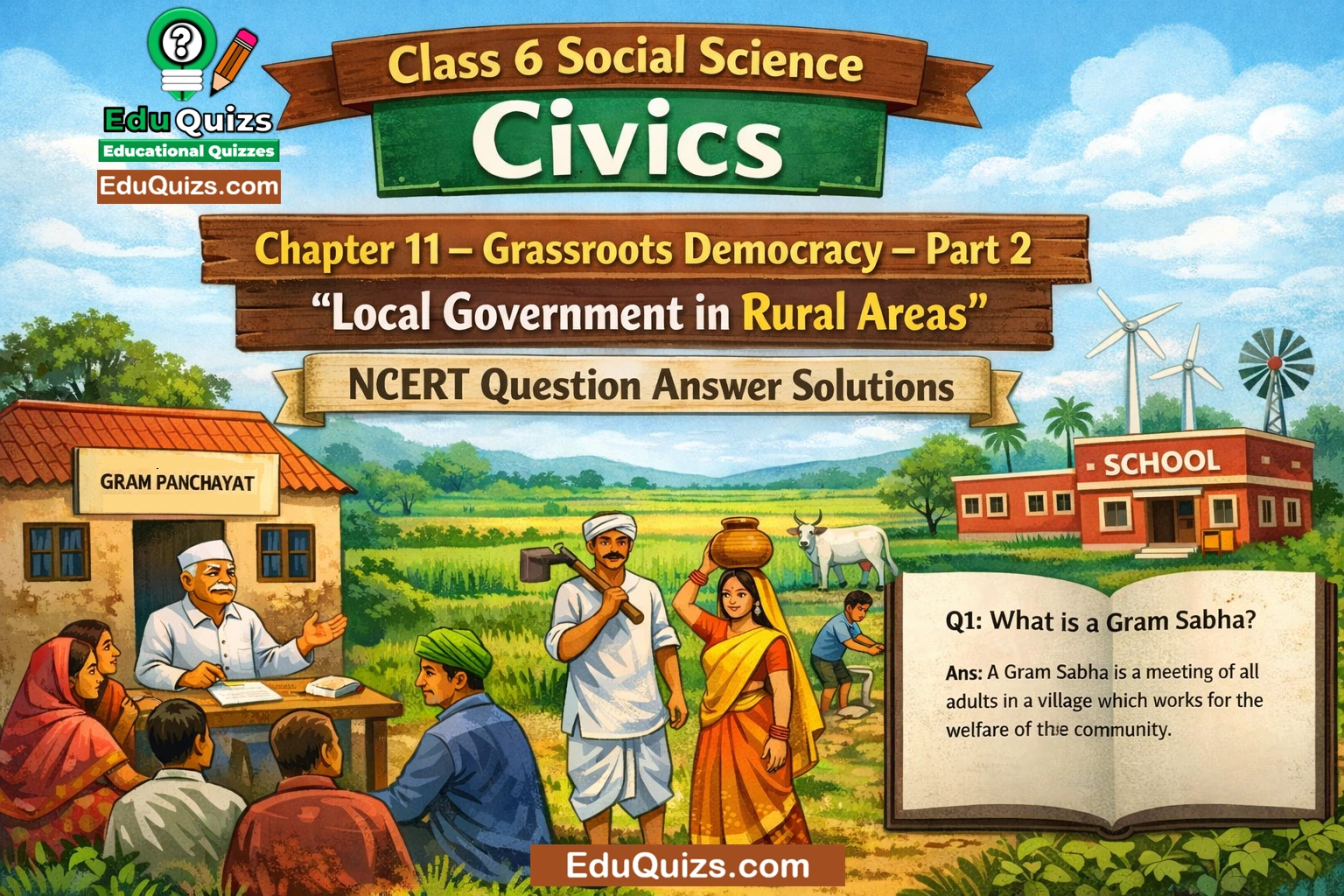
NCERT Solutions for Class 6 Social Science Civics Chapter 11 – Grassroots Democracy – Part 2 Local Government in Rural Areas
Class 6 Social Science Civics Chapter 11 – Grassroots Democracy – Part 2 Local Government in Rural Areas NCERT Question Answer Solutions.
Class 6 Social Science – Exploring Society: India and Beyond
Theme D – Governance and Democracy
SST Chapter 11: Grassroots Democracy – Part 2 Local Government in Rural Areas
Complete NCERT Question–Answer Set for Class 6 Social Science (Exploring Society: India and Beyond Textbook)
Class 6 Science NCERT Solution – SST Chapter 10: Grassroots Democracy – Part 2 Local Government in Rural Areas
Class 6 Social Science Civics Chapter 11 – Grassroots Democracy – Part 2 Local Government in Rural Areas NCERT Question Answer Solutions. SST – Grassroots Democracy – Part 2 Local Government in Rural Areas – Full NCERT Question–Answer Solution (CBSE Class 6 Social Science – Exploring Society: India and Beyond Book)
Chapter 11 – Grassroots Democracy: Part 2 Local Government in Rural Areas – Complete NCERT Question Answer Solutions
The Big Questions
(Class 6 Social Science Civics Chapter 11 – Grassroots Democracy – Part 2 Local Government in Rural Areas NCERT Question Answer Solutions)
1. What are Panchayati Raj institutions?
Answer
Panchayati Raj institutions are the system of local self-government in rural areas of India. They allow villagers to participate in decision-making and manage their own local affairs.
The Panchayati Raj system works through a three-tier structure:
- Gram Panchayat – Village level
- Panchayat Samiti – Block level
- Zila Parishad – District level
These institutions help solve local problems, plan development activities, and ensure that government schemes reach villages.
2. What are their functions?
Answer
The main functions of Panchayati Raj institutions include:
- Managing local development projects
- Maintaining roads, water supply, and sanitation
- Promoting agriculture and rural development
- Managing schools and health services
- Implementing government welfare schemes
- Resolving local disputes
- Encouraging people’s participation in governance
3. Why are they important in governance and democracy?
Answer
Panchayati Raj institutions are important because they:
- Bring government closer to the people
- Allow villagers to participate in decision-making
- Help solve local problems quickly and effectively
- Promote grassroots democracy
- Encourage development of villages
- Give representation to women and disadvantaged groups
Thus, they strengthen democracy at the local level.
(Class 6 Social Science Civics Chapter 11 – Grassroots Democracy – Part 2 Local Government in Rural Areas NCERT Question Answer Solutions)
Related Practice Questions:
- Class 6 Social Science Civics Chapter 11 MCQs
- Class 6 Social Science Civics Chapter 11 NCERT Question Answers
- Class 6 Social Science Civics Chapter 11 Extra Important Questions
- Class 6 Social Science Civics Chapter 11 Practice Worksheet
- Class 6 Social Science Civics Chapter 11 True False Questions
- Class 6 Social Science Civics Chapter 11 Fill in the Blanks
- Class 6 Social Science Civics Chapter 11 Match the Following
- Class 6 Social Science Civics Chapter 11 Summary Notes
THINK ABOUT IT
(Class 6 Social Science Civics Chapter 11 – Grassroots Democracy – Part 2 Local Government in Rural Areas NCERT Question Answer Solutions)
1. How do you think can these old maps be helpful for us? Can they tell us something about the past and the present?
Answer
Yes, old maps can be very helpful because they show how a village looked in the past.
They can help us:
- Understand changes in land ownership
- Identify old boundaries of fields and villages
- Study how villages have developed over time
- Compare past and present land use
- Resolve land disputes
Thus, old maps provide valuable information about both the history and development of a village.
2. Why do you think it is important for the government to pay more attention to the needs and problems of the disadvantaged sections of society?
Answer
It is important for the government to pay attention to disadvantaged groups because they often face many difficulties such as poverty, lack of education, and limited resources.
Special attention helps to:
- Ensure equality and fairness
- Improve living conditions
- Provide education and employment opportunities
- Protect their rights
- Promote social justice
This helps create a more inclusive and balanced society.
LET’S EXPLORE
(Class 6 Social Science Civics Chapter 11 – Grassroots Democracy – Part 2 Local Government in Rural Areas NCERT Question Answer Solutions)
1. As a class activity, let four or five students form a Bal Panchayat and the rest of the class imagine they are the villagers. What issues will the Gram Sabha discuss? What challenges could it encounter? What solutions will it propose?
Answer
Issues the Gram Sabha may discuss
- Clean drinking water
- Sanitation and cleanliness
- Repair of village roads
- School facilities
- Healthcare services
- Waste management
- Protection of the environment
Challenges it may face
- Lack of funds
- Lack of awareness among villagers
- Conflicts between villagers
- Delay in government approvals
Possible solutions
- Request funds from higher authorities
- Organize awareness campaigns
- Encourage community participation
- Work together to solve village problems
2. What similarities and differences do you notice between the governance system at the Central level and at the Panchayat level?
Answer:
Similarities
- Both have elected representatives
- Both make decisions for public welfare
- Both manage public resources
- Both work according to rules and laws
Differences
| Central Government | Panchayat Government |
|---|---|
| Works at national level | Works at village/local level |
| Led by Prime Minister and Parliament | Led by Sarpanch and Panchayat members |
| Deals with national issues | Deals with local village issues |
| Covers the whole country | Covers a small local area |
3. If you get an opportunity to meet a few Panchayat members, what questions would you like to ask them?
Answer
Some questions we can ask Panchayat members include:
- What are the main problems of our village?
- What development projects are currently being planned?
- How are government funds used in the village?
- How can villagers participate in Gram Sabha meetings?
- What steps are taken to improve education and healthcare?
- How does the Panchayat solve disputes among villagers?
End-of-Chapter Questions, Activities and Projects
(Class 6 Social Science Civics Chapter 11 – Grassroots Democracy – Part 2 Local Government in Rural Areas NCERT Question Answer Solutions)
1. Test yourself — without looking at the text above, can you name the three tiers of the Panchayati Raj system? What are the key functions of each of the three tiers?
Answer
The Panchayati Raj system is a system of local self-government in rural areas. It works at three levels, known as the three-tier system.
1. Gram Panchayat (Village Level)
This is the lowest and most important level of the Panchayati Raj system.
Key functions:
- Looks after the development of the village
- Maintains village roads and public places
- Manages water supply and sanitation
- Maintains schools and health centres
- Implements government schemes
- Solves local disputes and problems
2. Panchayat Samiti (Block Level)
The Panchayat Samiti works at the block level and acts as a link between Gram Panchayat and Zila Parishad.
Key functions:
- Coordinates work among different Gram Panchayats
- Prepares development plans for the block
- Implements government development programs
- Supervises village development projects
3. Zila Parishad (District Level)
The Zila Parishad functions at the district level.
Key functions:
- Supervises Panchayat Samitis
- Plans and manages district-level development
- Allocates funds for development projects
- Implements government schemes across the district
2. Write a letter to the Sarpanch regarding the issue of plastic bags lying on the roadside in the village.
Answer:
To
The Sarpanch
Gram Panchayat
Lakshmanpur Village
Subject: Request to remove plastic bags from village roadside
Respected Sir/Madam,
I am a student of the village school and a resident of Lakshmanpur village. I would like to draw your attention to the problem of plastic bags lying on the roadside in our village.
These plastic bags make the village look dirty and also harm animals and the environment. During rains, they block drains and cause waterlogging.
I request the Gram Panchayat to take necessary action to clean the roadside and create awareness among villagers to avoid using plastic bags. Dustbins should also be placed in public areas to keep the village clean.
I hope the Panchayat will take steps to solve this issue.
Thank you.
Yours sincerely
A concerned student
3. In your view, what type of person should be a Gram Panchayat member?
Answer:
A Gram Panchayat member should be a responsible and honest person who works for the welfare of the village.
The person should have the following qualities:
- Honest and trustworthy
- Responsible and hardworking
- Interested in village development
- Fair and unbiased in decision making
- Able to understand villagers’ problems
- Willing to work for education, health and cleanliness in the village
Such a person can help improve the living conditions of the villagers and promote development.
4. Let us suppose that you study in a village school. The school is located next to a highway and students find it difficult to cross the road when they come to school or leave at the end of the day.
(a) What are the options to solve this issue?
Answer:
Some possible solutions to this problem are:
- Construction of a speed breaker near the school
- Installation of a zebra crossing
- Putting up traffic warning signs
- Appointing a traffic guard or volunteer during school hours
- Construction of a foot overbridge or pedestrian crossing
- Creating awareness among drivers to slow down near schools
(b) Which institutions in the Panchayati Raj can help you?
Answer:
The following institutions of the Panchayati Raj system can help:
- Gram Panchayat – can raise the issue and take initial steps
- Panchayat Samiti – can coordinate and arrange resources
- Zila Parishad – can provide funds and approval for larger infrastructure projects
(c) What can the students do?
Answer:
Students can help solve the issue by:
- Writing a letter to the Sarpanch or Gram Panchayat
- Discussing the issue in the Gram Sabha
- Requesting teachers and parents to support the issue
- Creating awareness about road safety
- Participating in campaigns for safe school zones
By working together, students and the Panchayat can ensure safe roads near the school.
Key Exam Summary (Very Important)
(Class 6 Social Science Civics Chapter 11 – Grassroots Democracy – Part 2 Local Government in Rural Areas NCERT Question Answer Solutions)
Three tiers of Panchayati Raj
- Gram Panchayat – Village level
- Panchayat Samiti – Block level
- Zila Parishad – District level
Head of Gram Panchayat
Sarpanch / Pradhan
Important Officials
- Panchayat Secretary – Administrative work
- Patwari – Maintains land records
Reservation
- One-third seats reserved for women
- Seats reserved for disadvantaged groups
Importance
- Strengthens democracy
- Promotes local development
- Encourages people’s participation in governance
Subscribe our Youtube Channel for video. (Class 6 Social Science Civics Chapter 11 – Grassroots Democracy – Part 2 Local Government in Rural Areas NCERT Question Answer Solutions)