
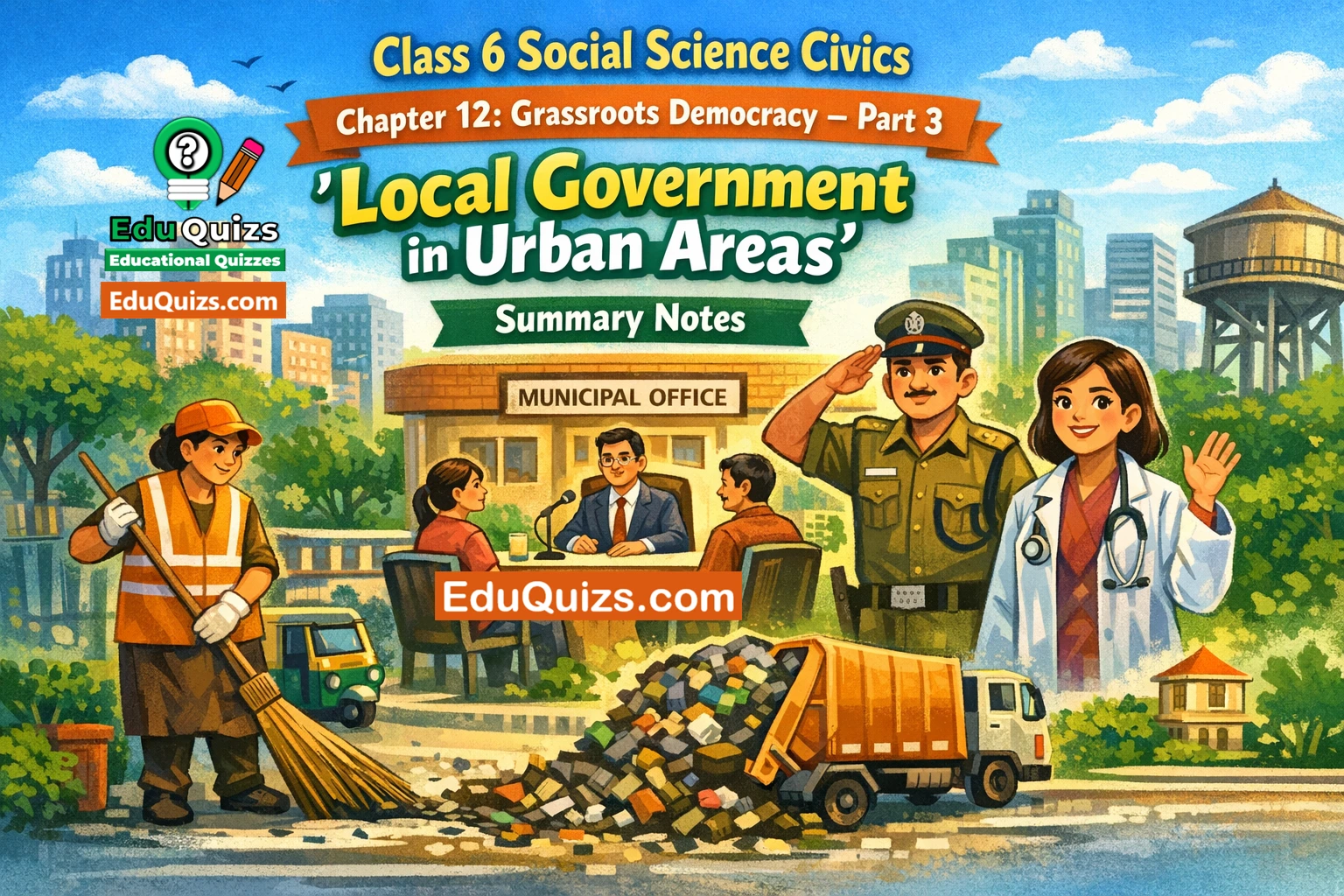
Class 6 Social Science Civics Chapter 12 – Grassroots Democracy – Part 3 Local Government in Urban Areas Summary Notes in English for CBSE students
CBSE Class 6 Social Science Chapter 12 Notes & Summary in English for “Grassroots Democracy – Part 3 Local Government in Urban Areas” (based on NCERT Social studies textbook Exploring Society: India and Beyond). Class 6 SST chapter 12 Summary Notes
SST Chapter 12 – Grassroots Democracy – Part 3 Local Government in Urban Areas Complete Notes
Class 6 Social Science – Exploring Society: India and Beyond
Theme D – Governance and Democracy
SST Chapter 12: Grassroots Democracy – Part 3 Local Government in Urban Areas
(Complete Notes + Concept-wise Explanation + Summary CBSE Class 6 Social Science – Exploring Society: India and Beyond (s.st.) Book)
Local Government in Urban Areas Complete CBSE Notes
1. Introduction
In a democratic country, governance does not happen only at the national or state level. It also occurs at the local level, where citizens can directly participate in decision-making.
Earlier, we studied local government in rural areas (Panchayati Raj). In this chapter, we study local governance in cities and towns, which is handled by urban local bodies.
Urban governance is usually more complex because cities have:
- Larger populations
- Diverse communities
- More infrastructure
- Many economic activities
Therefore, cities need well-organized local government systems.
2. Participatory Democracy
Participatory democracy means citizens actively participate in governance and decision-making.
Examples:
- Voting in elections
- Reporting civic problems
- Participating in local meetings
- Supporting development activities
Local government allows people to manage their own areas and solve local problems.
3. Levels of Government in India
India has three main levels of government:
1. Union Government
- National level
- Makes laws for the entire country.
2. State Government
- Governs each state.
3. Local Government
- Works at the village, town, and city level.
- Closest to the people.
Local government is divided into:
Rural Local Government
- Panchayati Raj Institutions
Urban Local Government
- Urban Local Bodies
4. Urban Local Bodies
Urban local bodies are local government institutions that manage cities and towns. fees112
They are decentralised, meaning power is distributed to local authorities instead of being controlled only by the central government.
Purpose
Urban local bodies help citizens:
- Manage their areas
- Solve local problems
- Participate in governance
5. Wards in Cities
Cities and towns are divided into smaller areas called wards.
Each ward has:
- Ward Committee
- Elected representative (Councillor)
Role of Ward Committees
Ward committees help:
- Organise health camps
- Conduct awareness campaigns
- Report civic problems
- Monitor local issues
Examples of issues they report:
- Water leakage
- Blocked drains
- Damaged roads
- Garbage problems
6. Functions of Urban Local Bodies
Urban local bodies perform many important functions. fees112
1. Infrastructure Development
- Construction and maintenance of roads
- Street lighting
- Drainage systems
2. Water Supply
- Providing clean drinking water
- Managing water tanks and pipelines
3. Sanitation
- Garbage collection
- Waste management
- Public toilets
4. Public Health
- Health camps
- Controlling diseases
5. Registration Services
- Birth certificates
- Death certificates
- Marriage certificates
6. Licensing
- Business licenses
- Trade permits
- Hoarding permits
7. Emergency Services
- Fire services
- Ambulance services
8. Planning Development
- Economic development
- Social welfare activities
Related Practice Questions:
- Class 6 Social Science Civics Chapter 12 MCQs
- Class 6 Civics Chapter 12 NCERT Question Answers
- Class 6 Civics Chapter 12 Extra Important Questions
- Class 6 Civics Chapter 12 Practice Worksheet
- Class 6 Social Science Civics Chapter 12 True False Questions
- Class 6 Social Science Civics Chapter 12 Fill in the Blanks
- Class 6 Social Science Civics Chapter 12 Match the Following
- Class 6 Social Science Civics Chapter 12 Summary Notes
7. Services Provided by Municipal Corporations
Example: Indore Municipal Corporation
Some services include:
- Property tax collection
- Water charges
- Garbage management
- Trade licenses
- Marriage certificates
- Fire services
- Tree cutting permissions
- Water tanker services
- Ambulance services
These services help maintain clean, organized, and safe cities.
8. Types of Urban Local Bodies
Urban local bodies are classified based on population size.
1. Municipal Corporation (Mahanagar Nigam)
For large cities with population above 10 lakh.
Examples:
- Mumbai
- Chennai
- Kolkata
- Delhi
Functions:
- Manage large cities
- Provide major civic services
Example:
The Municipal Corporation of Greater Mumbai was created in 1865.
2. Municipal Council (Nagar Palika)
For medium-sized cities with population between 1 lakh and 10 lakh.
Functions:
- Manage town infrastructure
- Provide civic services
3. Nagar Panchayat
For small towns or areas transitioning from rural to urban.
Functions:
- Manage small town administration
- Provide basic urban facilities
9. Oldest Municipal Institution in India
The Madras Corporation (Greater Chennai Corporation) is the oldest municipal institution in India.
Important facts:
- Established in 1688
- Created by the East India Company
- Allowed to collect municipal taxes in 1792
10. Funding of Urban Local Bodies
Urban local bodies need money to provide services.
They get funds through:
1. Taxes
- Property tax
- Water tax
- Local service tax
2. Fees
- Trade licenses
- Marriage certificates
- Hoarding permits
3. Government Grants
- Funds from state and central governments
4. Service Charges
- Water tanker services
- Garbage services
- Special permissions
11. Role of Citizens
Urban governance works effectively only when citizens cooperate.
Responsible citizens should:
- Segregate waste
- Keep surroundings clean
- Report water leaks
- Follow civic rules
- Participate in community activities
These actions help urban local bodies function efficiently.
12. Example – Clean City Indore
Indore has been ranked India’s cleanest city for seven consecutive years in the Swachh Survekshan survey.
This achievement was possible because of:
- Efficient municipal administration
- Active participation of citizens
- Proper waste segregation
- Cleanliness awareness
13. Difference Between Village and City Life
The chapter also compares village and city life through a conversation between Sameer and Anita.
Village Life
- People know each other
- Community cooperation
- Village Panchayat manages issues
City Life
- Large population
- Diverse communities
- Urban local bodies manage services
However, in both cases:
Democracy allows people’s voices to be heard.
14. Importance of Urban Local Bodies
Urban local bodies are important because they:
- Bring governance closer to people
- Allow citizen participation
- Solve local problems quickly
- Improve urban infrastructure
- Promote local development
They strengthen democracy at the grassroots level.
15. Key Concepts to Remember
Urban Local Bodies
Local government institutions that manage cities and towns.
Ward
A small administrative unit of a city.
Municipal Corporation
Urban local government for large cities.
Municipal Council
Local government for medium-sized cities.
Nagar Panchayat
Local government for small towns.
16. The Big Questions (Answers)
1. What are urban local bodies and what are their functions?
Urban local bodies are local government institutions that manage cities and towns.
They provide services such as water supply, sanitation, waste management, road maintenance, health services, and urban development.
2. Why are they important in governance and democracy?
Urban local bodies are important because they:
- Allow citizens to participate in decision-making
- Help manage local issues efficiently
- Strengthen democracy at the grassroots level
- Improve the quality of urban life
17. Summary of the Chapter
- Urban areas are governed by urban local bodies.
- Cities are divided into wards for better administration.
- Three types of urban bodies exist:
- Municipal Corporation
- Municipal Council
- Nagar Panchayat
- They provide essential services like water supply, sanitation, waste management, and infrastructure development.
- Citizens must actively participate to ensure effective governance.
Subscribe our Youtube Channel for video.