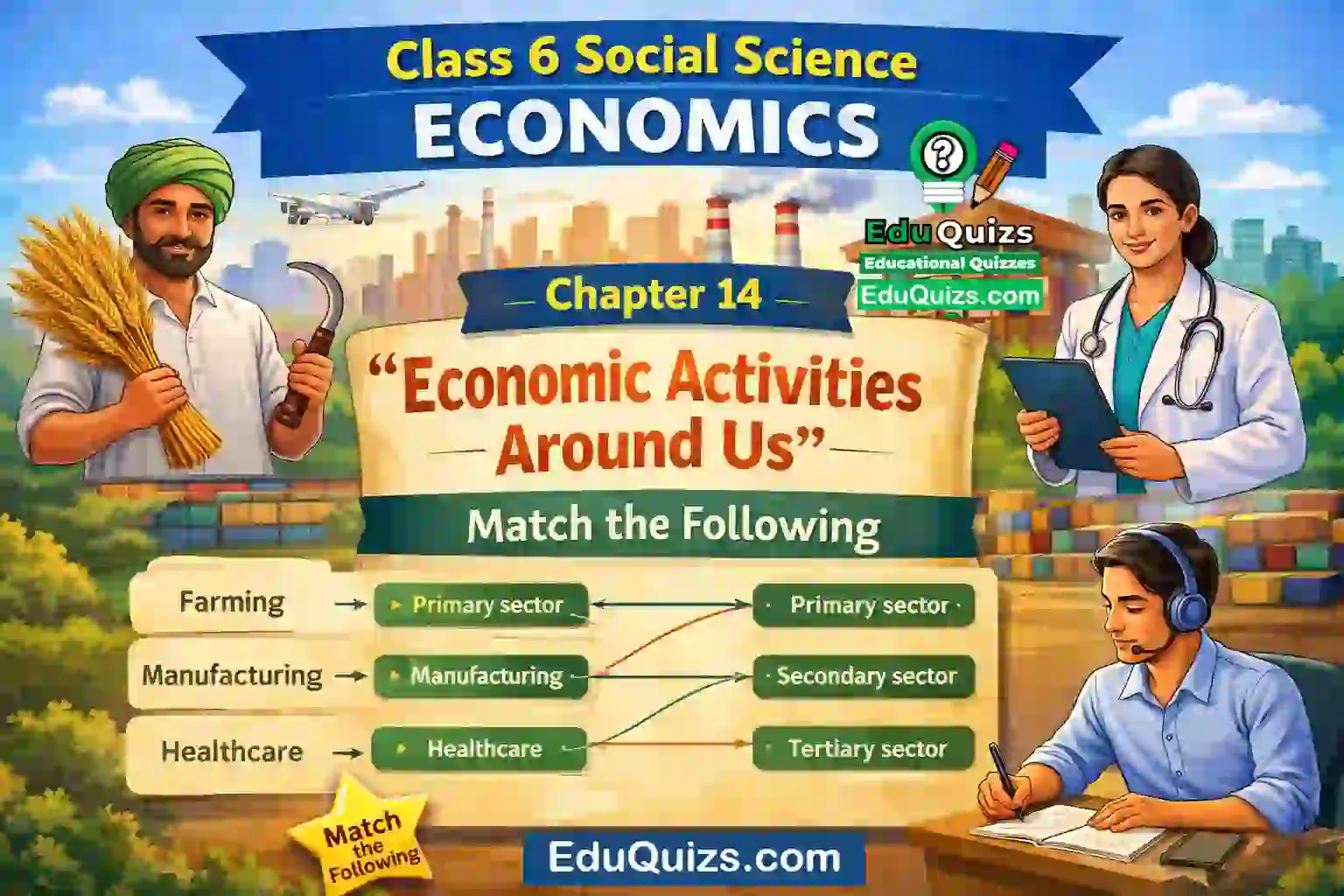

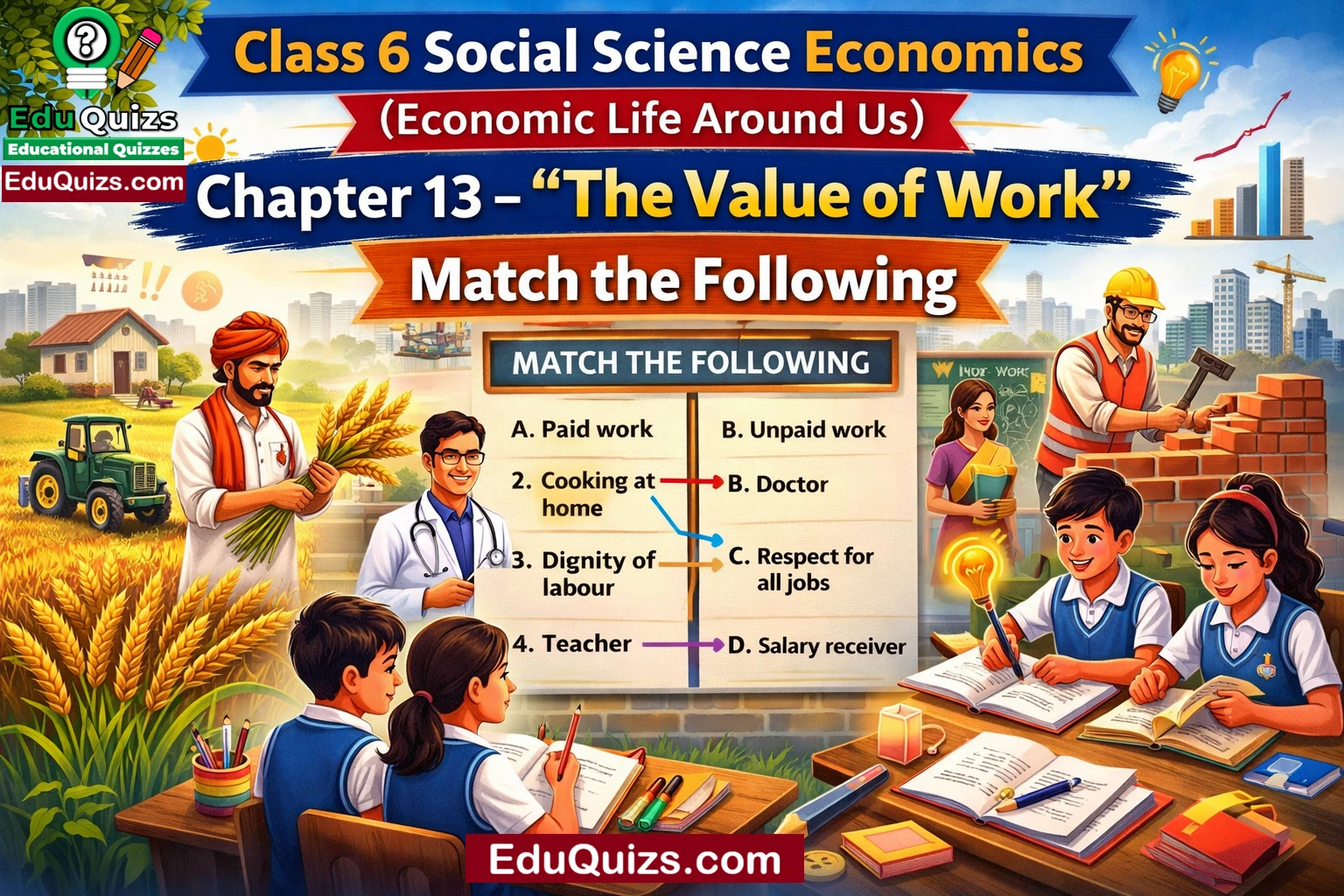
Class 6 Social Science Economics Match the Following – Chapter 13: The Value of Work
Class 6 Social Science Economics – Chapter 13: The Value of Work Match the Following. Class 6 Social Science Chapter 13: Match the Following Statement for “The Value of Work” (based on NCERT textbook Exploring Society: India and Beyond).
Match the Following with Answers for Practice – SST Chapter 13 – The Value of Work
Class 6 Social Science – Exploring Society: India and Beyond
Theme D – Economic Life Around Us
S. St. Chapter 13: The Value of Work
This includes Match the Following normally asked in school exams, tests, and NCERT exercises. – Class 6 Social Science Economics – Chapter 13: The Value of Work Match the Following
Set 1 – Class 6 Social Science Economics – Chapter 13: The Value of Work Match the Following Best and Easy
| Column A | Column B |
|---|---|
| 1. Carpenter | a. Selfless service |
| 2. Market | b. Fixed monthly payment |
| 3. Salary | c. Makes furniture |
| 4. Sevā | d. Exchange of goods and services |
| 5. Economic activity | e. Adds value to raw material |
| 6. Lawyer | f. Paid professional service |
| 7. Value addition | g. Activity done for money |
| 8. Non-economic activity | h. Work done without payment |
| 9. Doctor | i. Earns fee |
| 10. Farmer | j. Sells crops |
Answer Key:
1–c
2–d
3–b
4–a
5–g
6–i
7–e
8–h
9–f
10–j
Class 6 Social Science Economics – Chapter 13: The Value of Work Match the Following
Related Practice Questions:
- Class 6 Social Science Economics Chapter 13 The Value of Work MCQs
- Class 6 Economics Chapter 13 The Value of Work – NCERT Question Answers
- Class 6 Economics Chapter 13 The Value of Work – Extra Important Questions
- Class 6 Economics Chapter 13 The Value of Work – Practice Worksheet
- Class 6 Social Science Economics Chapter 13 The Value of Work – True False Questions
- Class 6 Social Science Economics Chapter 13 The Value of Work – Fill in the Blanks
- Class 6 Social Science Economics Chapter 13 The Value of Work – Match the Following
- Class 6 Social Science Economics Chapter 13 The Value of Work – Summary Notes
Set 2 – Class 6 Social Science Economics – Chapter 13: The Value of Work Match the Following Best and Easy
| Column A | Column B |
|---|---|
| 1. Wage | a. Helps children with homework |
| 2. Payment in kind | b. Goods instead of money |
| 3. Teacher | c. Educates students |
| 4. Software engineer | d. Develops computer applications |
| 5. Truck driver | e. Transport goods |
| 6. Parent cooking food | f. Non-economic activity |
| 7. Salary | g. Monthly payment |
| 8. Farmer | h. Grows crops |
| 9. Carpenter | i. Makes wooden furniture |
| 10. Daily labourer | j. Receives wage |
Answer Key:
1–j
2–b
3–c
4–d
5–e
6–f
7–g
8–h
9–i
10–j
Set 3 – Class 6 Social Science Economics – Chapter 13: The Value of Work Match the Following Best and Easy
| Column A | Column B |
|---|---|
| 1. Geeta Aunty | a. Software engineer |
| 2. Rohan | b. Indian Air Force pilot |
| 3. Kabir’s grandfather | c. Teaches Geography for free |
| 4. Anu’s parents | d. Run a garment shop |
| 5. Community service | e. Helping society |
| 6. Langar | f. Free food in gurudwara |
| 7. Volunteer work | g. Unpaid social work |
| 8. Non-economic activity | h. Work done without money |
| 9. Economic activity | i. Work done for income |
| 10. Market | j. Place to buy and sell goods |
Answer Key:
1–b
2–a
3–c
4–d
5–e
6–f
7–g
8–h
9–i
10–j
Set 4 – Class 6 Social Science Economics – Chapter 13: The Value of Work Match the Following Best and Easy
| Column A | Column B |
|---|---|
| 1. Rajesh | a. Wood cost |
| 2. Chair price | b. ₹1,000 |
| 3. Cost of wood | c. ₹600 |
| 4. Value addition | d. Skill and effort |
| 5. Carpenter | e. Makes furniture |
| 6. Market | f. Place to sell goods |
| 7. Economic activity | g. Paid work |
| 8. Furniture making | h. Example of value addition |
| 9. Wood | i. Raw material |
| 10. Chair | j. Finished product |
Answer Key:
1–e
2–b
3–c
4–d
5–e
6–f
7–g
8–h
9–i
10–j
Set 5 – Class 6 Social Science Economics – Chapter 13: The Value of Work Match the Following Best and Easy
| Column A | Column B |
|---|---|
| 1. Kavya | a. Visits village |
| 2. Bulldozer technician | b. Works on highway construction |
| 3. Highway construction | c. Reduces travel time |
| 4. Post office employee | d. Receives salary |
| 5. Online teacher | e. Charges weekly fee |
| 6. Sahil | f. Farm labourer |
| 7. Tractor | g. Used to till land |
| 8. Daily wage | h. Payment per day |
| 9. Payment in kind | i. Payment in goods |
| 10. Mango orchard | j. Place where mangoes grow |
Answer Key:
1–a
2–b
3–c
4–d
5–e
6–f
7–g
8–h
9–i
10–j
Set 6 – Class 6 Social Science Economics – Chapter 13: The Value of Work Match the Following Best and Easy
| Column A | Column B |
|---|---|
| 1. Economic activities | a. Done for earning money |
| 2. Non-economic activities | b. Done without money |
| 3. Parents helping children | c. Example of non-economic work |
| 4. Doctor | d. Charges fee |
| 5. Farmer | e. Sells crops |
| 6. Truck driver | f. Transports goods |
| 7. Factory worker | g. Works in industry |
| 8. Market | h. Exchange place |
| 9. Salary | i. Monthly payment |
| 10. Wage | j. Payment for work |
Answer Key:
1–a
2–b
3–c
4–d
5–e
6–f
7–g
8–h
9–i
10–j
Set 7 – Class 6 Social Science Economics – Chapter 13: The Value of Work Match the Following Best and Easy
| Column A | Column B |
|---|---|
| 1. Swachh Bharat Abhiyan | a. Cleanliness campaign |
| 2. Community participation | b. People working together |
| 3. Public places | c. Parks and streets |
| 4. Van Mahotsav | d. Tree planting festival |
| 5. Environment protection | e. Planting trees |
| 6. Citizens | f. Participate in campaigns |
| 7. Clean neighbourhood | g. Result of community effort |
| 8. Social welfare | h. Benefit to society |
| 9. Collective effort | i. Working together |
| 10. Nation | j. Entire country |
Answer Key:
1–a
2–b
3–c
4–d
5–e
6–f
7–g
8–h
9–i
10–j
Set 8 – Class 6 Social Science Economics – Chapter 13: The Value of Work Match the Following Best and Easy
| Column A | Column B |
|---|---|
| 1. Sevā | a. Selfless service |
| 2. Temple | b. Distributes prasad |
| 3. Gurudwara | c. Organises langar |
| 4. Mosque | d. Place of worship |
| 5. Church | e. Religious place |
| 6. Community kitchen | f. Free food |
| 7. Gratitude | g. Feeling of thankfulness |
| 8. Satisfaction | h. Result of helping others |
| 9. Charity | i. Helping needy people |
| 10. Society | j. Group of people |
Answer Key:
1–a
2–b
3–c
4–d
5–e
6–f
7–g
8–h
9–i
10–j
Set 9 – Class 6 Social Science Economics – Chapter 13: The Value of Work Match the Following Best and Easy
| Column A | Column B |
|---|---|
| 1. Baker | a. Bakes bread |
| 2. Tailor | b. Stitches clothes |
| 3. Scientist | c. Conducts research |
| 4. Doctor | d. Treats patients |
| 5. Farmer | e. Produces crops |
| 6. Carpenter | f. Makes furniture |
| 7. Shopkeeper | g. Sells goods |
| 8. Technician | h. Operates machines |
| 9. Software engineer | i. Develops software |
| 10. Teacher | j. Educates students |
Answer Key:
1–a
2–b
3–c
4–d
5–e
6–f
7–g
8–h
9–i
10–j
Set 10 – Class 6 Social Science Economics – Chapter 13: The Value of Work Match the Following Best and Easy
| Column A | Column B |
|---|---|
| 1. Economic life | a. Activities related to earning |
| 2. Value addition | b. Increasing product value |
| 3. Raw material | c. Basic material |
| 4. Finished product | d. Final goods |
| 5. Skill | e. Ability to do work |
| 6. Effort | f. Hard work |
| 7. Time | g. Needed to complete work |
| 8. Money | h. Medium of exchange |
| 9. Work | i. Activity done to produce goods |
| 10. Society | j. People living together |
Answer Key:
1–a
2–b
3–c
4–d
5–e
6–f
7–g
8–h
9–i
10–j
Subscribe our Youtube Channel for video. Class 6 Social Science Economics – Chapter 13: The Value of Work Match the Following
FAQ – Class 6 Social Science Economics – Chapter 13: The Value of Work Match the Following
1. What are Class 6 Social Science Economics – Chapter 13: The Value of Work Match the Following?
Match the Following questions are activity-based questions where students connect related concepts from two columns. In this chapter, students match types of work with examples or definitions, helping them understand relationships between concepts like paid work, unpaid work, and professions.
2. Why are Match the Following questions important for students?
These questions improve logical thinking and help students connect concepts easily. They also make learning interactive and improve memory retention, which is helpful during exams.
3. What topics are included in Match the Following for this chapter?
Topics include types of work (paid and unpaid), examples of professions, dignity of labour, and roles of different workers in society.
4. How do Match the Following questions help in exams?
They help students quickly revise multiple concepts at once and are often included in exams as they are easy to attempt and score.
5. What is the concept of paid and unpaid work in this chapter?
Paid work refers to work done in exchange for money, such as jobs like teaching or construction work. Unpaid work includes household tasks like cooking and cleaning, which are important but not paid.
6. What is dignity of labour and how is it tested in these questions?
Dignity of labour means respecting all types of work equally. In Match the Following, students may match this concept with its correct definition or examples.
7. How can students practice Match the Following effectively?
Students should revise concepts, create their own matching exercises, and practice worksheets regularly to strengthen their understanding.
8. Are Match the Following questions easy to score in exams?
Yes, these questions are generally easy and scoring if students have a clear understanding of the concepts.
9. How many Match the Following questions should students practice?
Students should practice at least 10–20 sets to cover all important topics and improve speed and accuracy.
10. Where can I find the best Match the Following questions for this chapter?
You can find well-structured and exam-oriented questions on educational platforms like EduQuizs.com, which provide complete study material for Class 6 students.