
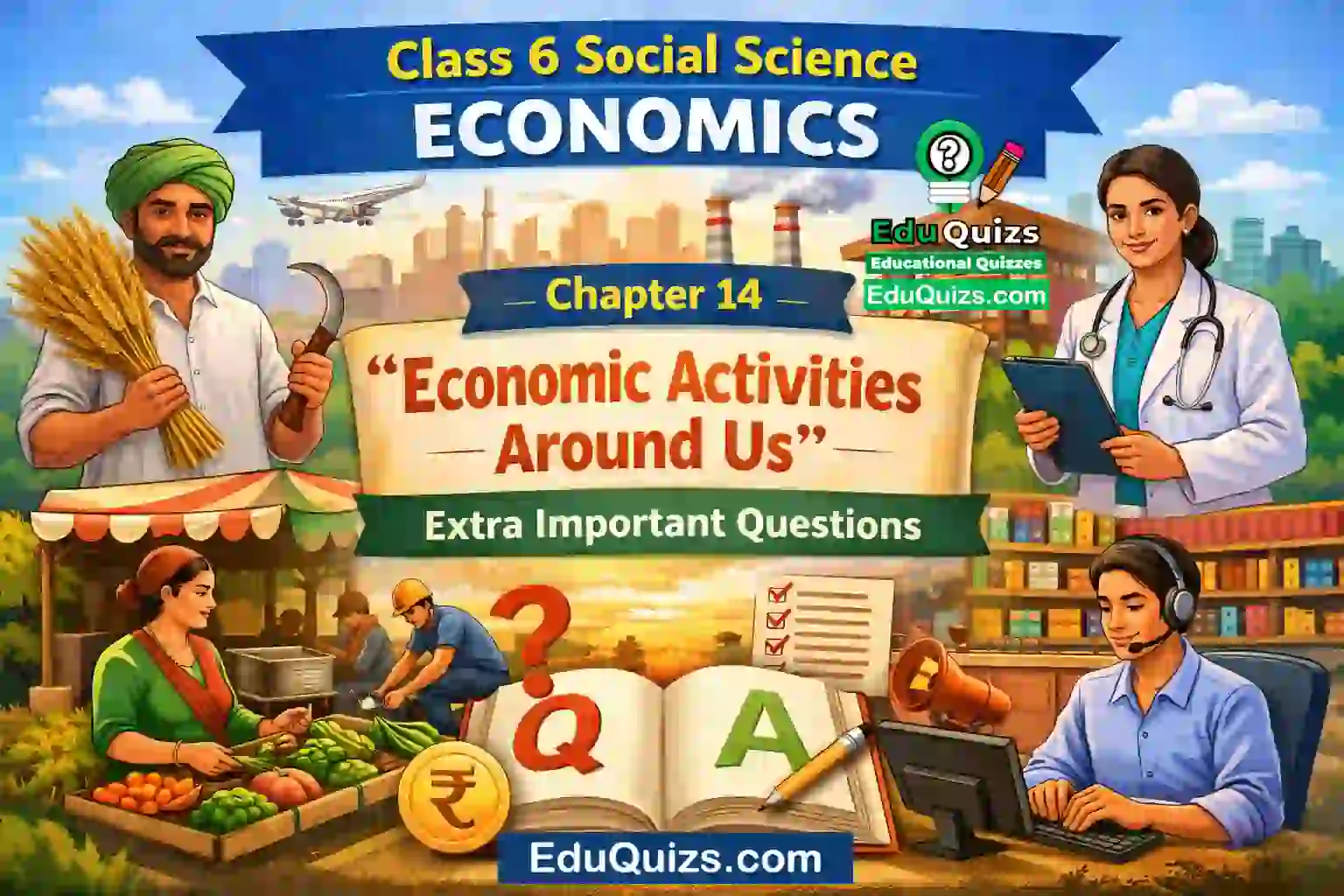
Class 6 Social Science Economics Chapter 14 – Economic Activities Around Us Extra Important Questions & Answers
Class 6 Social Science Economics Chapter 14 – Economic Activities Around Us – Extra Important Questions. Class 6 Social Science Chapter 14 Extra Questions and Answers for SST “Economic Activities Around Us” (based on NCERT textbook Exploring Society: India and Beyond).
EXTRA IMPORTANT QUESTIONS WITH ANSWERS – Social Studies Chapter 14 – Economic Activities Around Us
Class 6 Social Science – Exploring Society: India and Beyond
Theme D – Economic Life Around Us
SST Chapter 14: Economic Activities Around Us
Class 6 Social Science Economics Chapter 14 – Economic Activities Around Us – Extra Important Questions. This includes All types of Questions normally asked in school exams, tests, and NCERT exercises.
Class 6 Social Science Economics Chapter 14 – Economic Activities Around Us – Extra Important Questions with Answers
A. Very Short Answer Questions (1–2 marks)
(Class 6 Social Science Economics Chapter 14 – Economic Activities Around Us – Extra Important Questions)
1. What are economic activities?
Activities that generate income (monetary value) are called economic activities.
2. What is monetary value?
The value of something that can be measured in money.
3. What are economic sectors?
Economic sectors are groups of similar economic activities.
4. Name the three economic sectors.
- Primary sector
- Secondary sector
- Tertiary sector
5. What is the primary sector?
It includes activities that depend directly on nature.
6. What is the secondary sector?
It involves processing raw materials into finished goods.
7. What is the tertiary sector?
It provides services to support other sectors.
8. What is another name for the tertiary sector?
Service sector
9. What is a cooperative?
A group of people working together to meet common economic needs.
10. Who are middlemen?
People who buy goods from producers and sell to consumers.
Related Practice Questions:
- Class 6 Social Science Economics Chapter 14 Economic Activities Around Us MCQs
- Class 6 Economics Chapter 14 Economic Activities Around Us – NCERT Question Answers
- Class 6 Economics Chapter 14 Economic Activities Around Us – Extra Important Questions
- Class 6 Economics Chapter 14 Economic Activities Around Us – Practice Worksheet
- Class 6 Social Science Chapter 14 Economic Activities Around Us – True False Questions
- Class 6 Social Science Economics Chapter 14 Economic Activities Around Us – Fill in the Blanks
- Class 6 Social Science Chapter 14 Economic Activities Around Us – Match the Following
- Class 6 Social Science Economics Chapter 14 Economic Activities Around Us – Summary Notes
B. Short Answer Questions (2–4 marks)
(Class 6 Social Science Economics Chapter 14 – Economic Activities Around Us – Extra Important Questions)
11. Why are economic activities classified?
Economic activities are classified to:
- Understand their nature and function
- Study their importance
- Understand the relationship between different activities
12. Give examples of primary sector activities.
- Agriculture
- Fishing
- Mining
- Forestry
13. Give examples of secondary sector activities.
- Making clothes from cotton
- Furniture making
- Car manufacturing
- Construction of buildings
14. Give examples of tertiary sector activities.
- Banking
- Transportation
- Healthcare
- Education
15. Why is the primary sector important?
- It provides raw materials
- It is the base of all economic activities
16. Why is the tertiary sector important?
- It provides essential services
- Helps in transport, communication, and trade
17. What is meant by interdependence of sectors?
All sectors depend on each other for production, processing, and distribution.
18. What role do transport services play?
- Carry goods from one place to another
- Help in distribution and trade
C. Long Answer Questions (4–6 marks)
(Class 6 Social Science Economics Chapter 14 – Economic Activities Around Us – Extra Important Questions)
19. Explain the three sectors of economic activities.
Primary Sector:
- Uses natural resources
- Example: farming, fishing
Secondary Sector:
- Processes raw materials
- Example: factories, construction
Tertiary Sector:
- Provides services
- Example: banking, transport
20. Explain the interdependence of economic sectors with an example.
Example: Milk production
- Farmers produce milk → Primary sector
- Milk processed into butter/cheese → Secondary sector
- Transport and selling → Tertiary sector
All sectors depend on each other for smooth functioning.
21. Explain the role of cooperatives in economic activities.
- Help people work together
- Remove middlemen
- Increase income
- Ensure fair prices
- Example: Dairy cooperatives
22. Describe the importance of the secondary sector.
- Converts raw materials into usable goods
- Creates employment
- Supports economic growth
D. Case-Based Questions
(Class 6 Social Science Economics Chapter 14 – Economic Activities Around Us – Extra Important Questions)
23. Read the case and answer:
Farmers produce milk, factories make butter and cheese, and shops sell them.
Questions:
a) Identify the sectors involved
b) Explain their roles
Answer:
- Primary: Milk production
- Secondary: Processing milk
- Tertiary: Selling and transport
E. Assertion–Reason Questions
(Class 6 Social Science Economics Chapter 14 – Economic Activities Around Us – Extra Important Questions)
24. Assertion: Primary sector uses natural resources
Reason: It produces finished goods
Answer:
Assertion is correct, Reason is incorrect
25. Assertion: Tertiary sector is important
Reason: It provides services
Answer:
Both are correct and Reason explains Assertion
F. Higher Order Thinking Questions (HOTs)
(Class 6 Social Science Economics Chapter 14 – Economic Activities Around Us – Extra Important Questions)
26. What will happen if the primary sector stops working?
- No raw materials
- Industries will stop
- Services will also stop
27. What will happen if transport services stop?
- Goods cannot reach markets
- Trade will stop
- Economy will suffer
28. Why are all three sectors equally important?
- Each sector performs a unique role
- All depend on each other
- Economy cannot function without any one sector
G. Diagram-Based Question
(Class 6 Social Science Economics Chapter 14 – Economic Activities Around Us – Extra Important Questions)
29. Draw a flow diagram showing interdependence of sectors
Primary Sector
↓
Raw materials
↓
Secondary Sector
↓
Finished goods
↓
Tertiary Sector
↓
Distribution to consumers
H. Value-Based Question
(Class 6 Social Science Economics Chapter 14 – Economic Activities Around Us – Extra Important Questions)
30. How do cooperatives help farmers?
- Provide fair prices
- Reduce exploitation
- Increase income
- Promote unity and cooperation
I. Competency-Based Questions
(Class 6 Social Science Economics Chapter 14 – Economic Activities Around Us – Extra Important Questions)
31. Identify the sector:
a) A farmer growing wheat → Primary
b) A factory making bread → Secondary
c) A shop selling bread → Tertiary
32. Match the following:
| Activity | Sector |
|---|---|
| Mining | Primary |
| Manufacturing | Secondary |
| Banking | Tertiary |
J. One-Line Revision Questions
(Class 6 Social Science Economics Chapter 14 – Economic Activities Around Us – Extra Important Questions)
- Economic activities create → Monetary value
- Primary sector uses → Natural resources
- Secondary sector makes → Finished goods
- Tertiary sector provides → Services
- Example of cooperative → Dairy (milk)
- Interdependence means → Mutual dependence
Final Tip for Exams
Focus on:
- Definitions (very important)
- Differences between sectors
- Interdependence examples
- Case study (milk/AMUL type)
Subscribe our Youtube Channel for video.